Don’t forget to enter our book giveaway!
In 2019, I started flying. It had been over ten years since I went on my first and last, until recently, flight, a trans-Atlantic one that had lasted 12 hungover, painful hours. I’d vowed never to fly again, and, until my work as a writer began to gain a little traction, I didn’t have to. I took buses and trains, I drove long, anxious hours on the highway in pristine, rented cars. I always rented an SUV or a pick-up truck to feel safer as the whale-like hulks of buses and semis passed me on the road.
On my first flight to Portland in March of 2019 to launch one of my books at the Association of Writers & Writing Programs’ annual conference, I looked at the carbon emissions printed on my ticket and wondered if it was worth it. This was after the doomsday reports of climate change had begun, and, seated with many other people on the plane, dosed up with CBD to curb my flight anxiety, I thought of the cost versus the benefit. Sure, there was a personal benefit, but what was the larger one? My book, a tiny collection of essays about my life as a transgender person, was something I should be promoting, should be getting into as many hands as possible. But I looked and looked at the carbon emissions, tried to calculate what harm I was doing to the planet and humanity versus what good I was doing. How many people would I reach with a message that transness was as valid a part of humanity as any of the myriad human variations? How many minds or hearts could I change? Would those people who needed the changing even be somewhere like where I was going, anyway?
I am bad at math, and such things cannot always be measured in numbers.
*
There is much talk, here at the seeming end of things, about how we, as individuals, can change the direction our world is hurtling in with terrifying speed. We can eat less meat. We can travel less. We can recycle. I think these things are, often, a red herring meant to distract from the true culprits of climate change: massive, untaxed, unchecked capitalist ventures, underhanded politicians and leaders, billionaires who never do the sort of calculation I did on that plane. I am not sure that the individual actions of many could ever counter the bad behavior of the privileged few. Yet, the ways I could and sometimes don’t change my own behavior haunts me. I was raised in the ‘80s, a “gifted program” child who was told every day by teachers that the world was in crisis, there was a hole in the ozone layer, and that we, bright-faced, eager young people, would have to be the ones to save it. I didn’t do anything. I wrote a few books that may or may not be worth the trees that died for them. The expectations of those grade school teachers that we would save a world they would long be gone from still haunts me.
*
There have been multiple, interesting studies done on trees. About how they form bonds and care for each other, feeding one another through a complex forest root system. How they “talk” to one another in subtle, intricate ways. I am fascinated by this life that exists calmly under the perception of human beings. I am moved by their interdependence, their quiet communication, and gentle care. I wonder if the words I print on pages made from their deaths could ever be worth these soft things.
Many suggest that if we were to apply ourselves deeply, as humans, to planting new forests, we could change the path of our own doom.
*
My book tour was an incredible waste of resources, speaking in terms of the planet. It was ironic because it clearly negated any of the work done by my second novel, which was about building community and surviving climate change. I went all over the country in cars and planes and buses to speak to people. At one event, a man asked me if I’d feel different about the things I’d written about if I had money.
I am trying. A book on climate change — how many trees did that take? How many carbon emissions to present it to little groups of people who were already on board with its message? Does it count not to change hearts, but to strengthen them?
I tell a room full of people to look at the faces around them and know these others are the ones they will be fighting alongside for their and their children’s survival.
*
Towards the beginning of fall, I am home from my book tour. What it has cost is heavy on me, but I am light as I rent a car and begin to drive. I am driving an hour east, towards Geneva, Ohio, where my best friend since childhood and her family live. She is having a baby, a little boy, my nephew.
Along the way, I drive back roads, even though it takes more time, more gas, more emissions. I listen to the Tom Waits song “Jersey Girl.” It is a song about driving from New York City to New Jersey regularly to see someone the singer loves. I weigh the cost of that constant trip in my head, measure it against when the song was written, in the ‘80s, and now. What is the cost of love? What is the cost of distance? Can you possibly measure the benefits?
I think of my niece, Bella, who is 12, who I love with all my heart. She is waiting at the end of this trip, at the end of the planet-damaging ride. She has been nervous about her new baby brother coming, behind a facade of tween angst. It is worth it to be there, to take her out to lunch, to talk to her as much as she will let me. It is worth it to see the face of this new little person in the world as soon as anyone does. It is worth it to be able to talk to him when he is new to the world, to let him know how scary things are getting, and that much more of it will fall on him than on us. I will not give him solutions or tell him he is responsible for the mess all the rest of us have made. I will end this ceaseless weighing of costs, just for today. I will hold this new life, and let him know that I have seen many faces over the last month, ones rife with hope and personal commitment to doing the right thing, try to describe these faces so that he might recognize them one day, when all the benefits are gone, and we are left with the horrible cost.
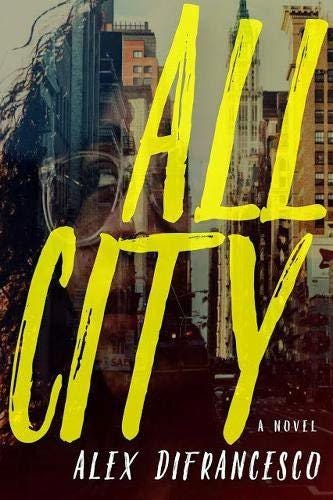
All City is a novel about climate change, gentrification, street art, and a near-future, storm-battered New York City from which the wealthy escape while those without means are left to die or rebuild on their own. You can find out more here.
Alex DiFrancesco is the author of All City, Psychopomps, and Transmutation. They live in Cleveland, OH with their Westie, Roxy Music, Dog of Doom.
 Climate Fiction Writers League